
Process Design
Manufacture of Dicyandiamide - A Circular Economy
An integrated process for the production of DCDA from calcium carbide, nitrogen and carbon dioxide, with impure burnt lime as the by-product.
Dr. D.M. Mohunta, Commercial, Chemical and Development Company
Dicyandiamide (DCDA) is a basic raw material for manufacturing guanide chemicals. It is the major raw material for metformin, an anti-diabetes drug and perhaps India is the largest producer of this drug in the world.
The main raw material for making DCDA is calcium carbide, a product that requires large amount of power. At present, there is no merchant production of calcium carbide in India, and the country depends on imports of both calcium carbide and DCDA. The largest source of both these chemicals is China, though lesser quantities are imported from sources in Europe.
This article presents an integrated process for production of DCDA from calcium carbide (CaC₂), with the other inputs being nitrogen and carbon dioxide (CO₂). The by-product is impure burnt lime (CaO).
Manufacture of dicyandiamide
The three stages involved in the manufacturing of DCDA from calcium carbide are:
- Step 1: Synthesis of calcium cyanamide.
- Step 2: Synthesis of cyanamide.
- Step 3: Synthesis of DCDA.
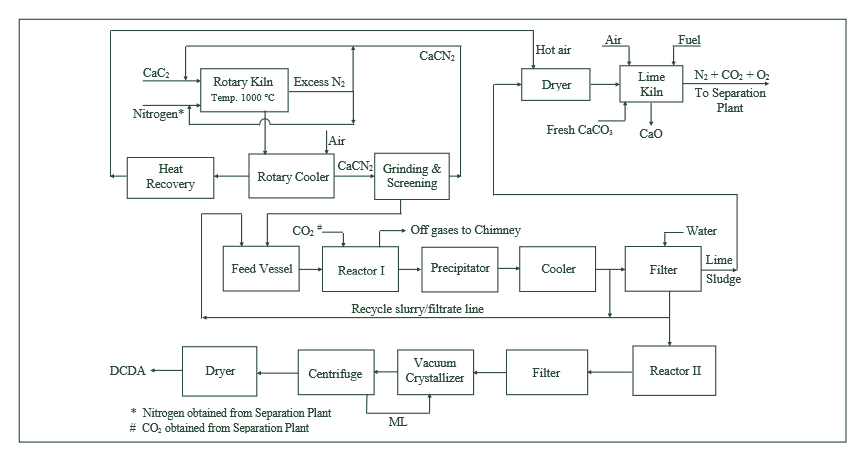
The process is indicated in Figure 1. It will be noted that during the process calcium carbonate is generated; if this can be converted after suitable processing to burnt lime then the off gases of kiln can be processed to get pure streams of nitrogen and CO₂ for recycling. Thus, only small quantities of additional lime etc. would be required to make up the losses.
Step 1: Calcium cyanamide synthesis
Calcium cyanamide (CaCN₂) is synthesised from calcium carbide and nitrogen in a rotary kiln. This continuous process is known as the Trostberg process. The reaction is highly exothermic; however in the beginning a heat source is required to pre-heat the mixture to around 1000°C. Once the reaction starts the heat source is removed. The reaction continues by controlled addition of nitrogen.
CaC₂ + N₂ → CaCN₂ + C 1000–1100°C; ΔH = −289 KJ/mol
The conversion rate depends on temperature, nitrogen partial pressure, carbide purity and on the particle size of calcium carbide.
Calcium cyanamide is formed through a number of intermediates, and is cooled after coming out of the rotary kiln in a rotary cooler with air. The hot air from the cooler is utilised to dry the lime sludge in the later stage. Cooled calcium cyanamide is ground and screened to an adequate particle size for the downstream operation.
Raw material consumption, per 1,000 kg of CaCN₂ as 100%, or 1,425 kg of 70% CaCN₂, is: calcium carbide (1,080 kg), nitrogen (550 Nm³).
Table 1: Typical analysis of calcium cyanamide
| Assay | % |
|---|---|
| Calcium cyanamide | 65.0–70.0 |
| Burnt lime (CaO) | 10.0–12.0 |
| Carbon | 10.5–12.5 |
| Calcium fluoride (CaF₂) | 0.5 |
| Calcium sulphide (CaS) | 1.0 |
| Calcium carbide | 0.2–0.5 |
| Other nitrogen impurities | 1.5 |
| Other mineral impurities | 6.5–7.0 |
Step 2: Cyanamide synthesis
In the second step, cyanamide is manufactured from calcium cyanamide by continuous carbonation in aqueous medium.
CaNCN + H₂O + CO₂ → H₂NCN + CaCO₃
In the continuous cyanamide process, the amount of calcium cyanamide and water added is equivalent to the aqueous cyanamide removed.
A carbonated slurry of cyanamide solution, solid calcium carbonate and graphite is cooled to remove the heat of reaction. Part of the slurry is recycled to facilitate temperature control, while the remainder is filtered yielding cyanamide solution and a cake of calcium carbonate and carbon/graphite. The filtered solution is also recycled in order to control the solids content. The final concentration of cyanamide is normally maintained at 25%.
The calcium cyanamide feed is well mixed with the recycled slurry and filtrate in a feed vessel. The calcium cyanamide is added at a rate to maintain a pH of 6.0–6.5 in the cooling tank. The carbonation step can be conducted in an agitated vessel with a residence time of a few minutes. After the carbonation step, the slurry is held at 30–40°C to complete the formation of calcium carbonate, after which the slurry is cooled and filtered. All equipment for the process is preferably of stainless steel. The resulting solution is used directly for conversion to DCDA.
The waste from the process is a mixture of calcium carbonate and carbon or graphite. This can be sold to cement manufacturers or it can be used to obtain CO₂ and N₂ needed for the process.
Raw material consumption, per 1,000 kg of cyanamide, is: calcium cyanamide (70%) (2,805 kg); carbon dioxide (700 m³ at NTP); calcium carbonate waste (84%) (3,500 kg).
Table 2: Typical analysis of commercial cyanamide
| Product / Component | Assay % |
|---|---|
| Anhydrous, Cyanamide-100 | |
| Cyanamide | 96.0 |
| Dicyandiamide | 1.0 |
| Urea | 0.5 |
| Water | 0.5 |
| NaH₂PO₄ (stabilizer) | 2.0 |
| Aqueous 50%, Cyanamide-50 | |
| Cyanamide | 50.0 |
| Dicyandiamide | 1.5 |
| Urea | 0.2 |
| NaH₂PO₄ (stabilizer) | 2.0 |
| Water | 46.3 |
Step 3: Dicyandiamide synthesis
DCDA is manufactured by dimerization of cyanamide in an aqueous solution. The 25% cyanamide solution is adjusted to pH 8–9, and held at approximately 80°C for two hours to give complete conversion.
The hot liquor is filtered and transferred to an evaporative vacuum crystallizer, and then the concentrated solution is cooled. The slurry of DCDA is separated in continuous centrifuges and the solids passed to rotary driers. The finished material is stored in bulk or in bags.
The mother liquor is partly recycled to the cyanamide extraction system and partly purged to keep the thiourea content low.
In the three steps enumerated many of the operating conditions are to be closely controlled to prevent formation of by-products and impurities. The quality of the final product also depends upon the quality of inputs.
Table 3: Typical analysis of commercial DCDA
| Assay | % |
|---|---|
| Dicyandiamide | 99.30 |
| Water | 0.01 |
| Melamine | 0.70 |
| Thiourea | 200.00 ppm |
| Heavy metals | 10.00 ppm |
Supply of carbon dioxide and nitrogen
These are important inputs and two schemes are possible.
Alternate 1
The grey carbonate sludge can be sold to cement manufacturer. CO₂ and N₂ needed for the process can be supplied by a lime kiln with feed of fresh limestone and gas. The burnt lime or hydrated lime is sold.
Alternate 2
A suggested method is to dry the carbonate sludge by hot air from the calcium cyanamide cooler. Dried mixture is then fed to the lime kiln. Thus the feed is a mixture of CaCO₃, and C in the form of carbon or graphite. The carbon content is the heat source for conversion of CaCO₃ to CaO and CO₂.
A closer look indicates that there is large excess of carbon in the sludge over that required to convert the carbonate. A solution that utilizes the energy in excess carbon is to add equivalent quantity of fresh limestone (90–92% or lower grade). Small amount of extra fuel is required to start the calcination process. The low grade burnt or hydrated lime can used for effluent treatment.
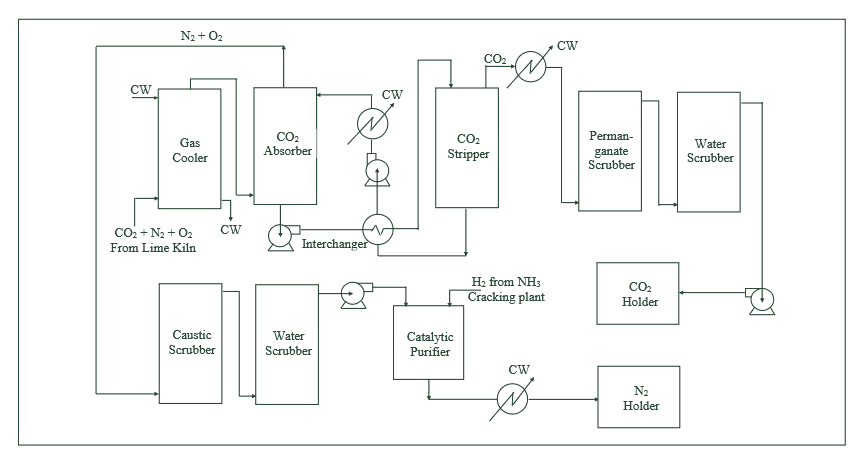
Rotary kiln with coal gas or gas fired kiln can be used. Minimum excess is required for firing. The outlet gas from the lime kiln is a mixture of N₂ + CO₂ + O₂. This mixture is separated in the separation plant as indicated in Figure 2.
The production of CO₂ is much in excess than required for the process. The excess CO₂ can be processed and sold as liquid CO₂, or let out to atmosphere. The nitrogen after the removal of CO₂ is made free from oxygen by catalytic hydrogenation. The nitrogen processing capacity should be to meet internal demand. However, if nitrogen can be used for blanketing or piped to other users for this purpose then larger capacity can be considered.
Economics
Calcium carbide is the key raw material. Presently, it is wholly imported. In 1987, Chemical Weekly reported an Indian production capacity of 259,480-tpa. But because of issues of electrical cost and quality of power the industry collapsed.
The cost of imported calcium carbide during the Nov. 2019 to Jan. 2020 varied from $655 to $688 per tonne. The average, $673.60, at constant Rs./$ conversion factor of Rs. 72.0, works out to a price of Rs. 48.50/kg.
In its issue dated June 30, 2020, Chemical Weekly has reported figures of DCDA imports and prices from China as follows: 2017–18 ($1,709/tonne), 2018–19 ($2,104/tonne) and 2019–20 (April–Dec) ($1,711/tonne). Imports from Germany in 2018 were at an average price of $2,371/tonne. The German price of about Rs. 170/kg is usually 30–40% higher than the Chinese prices. It is of better quality, in terms of impurities.
The Chinese price of DCDA is Rs. 122/kg. At a consumption ratio of 2.15 kg/kg of DCDA – the cost of carbide alone is Rs. 104, leaving a gross margin Rs. 18/kg.
The raw material cost is 85% of the sale price. Even if it is assumed that the cost of CO₂ and N₂ is taken care of by the sale of by-products, it will barely cover the cost of utilities. It does not cover repairs, manpower, overheads, financial costs, etc.
Viability may be achieved only if the raw material price is approximately 60–65% of the sale price for capacity of about 8,000-tpa to 10,000-tpa. The other alternative is to produce calcium carbide in India. The power consumption is approximately Rs. 2,800 to Rs. 3,000 per kWh/tonne of calcium carbide. A source of low-cost power is co-gen power from captive power plant, but this means a quantum jump in investment.
Conclusion
There is large market for DCDA in India to consider its production here. However, the production of DCDA, based on imported calcium carbide, is not viable. The proposition is viable only if the cost of calcium carbide can be reduced considerably.