
Energy
Coal Gasification in India — the Unfinished Story
D.M. Mohunta on why India — despite a National Coal Gasification Mission and Rs 8,500-crore in incentives — still trails China’s 700-plus gasifiers, and what it will take to close the gap.
D.M. Mohunta, Commercial, Chemical and Development Company (dmm@ccdcindia.com). First published in Chemical Weekly, 30 April 2024.
Coal gasification as we know today and touted as great panacea has been practiced in large scale since 1936 in Germany. The purpose was to use the gas produced as fuel for industry and households, and many hundred kilometres of gas pipelines were laid in Europe. By 1946, coal gasification was recognised as an important source of syngas (synthesis gas – a mixture of carbon monoxide and hydrogen) for chemical production in USA and Germany. Very detailed work was done on all aspects of gasification of coke and lignite under widely differing operating conditions.
This author has been advocating not only coal gasification, but gasification of heavy tar and other low value fuels since 2006. There were few who listened and most enamoured with natural gas, pooh-poohed the idea.
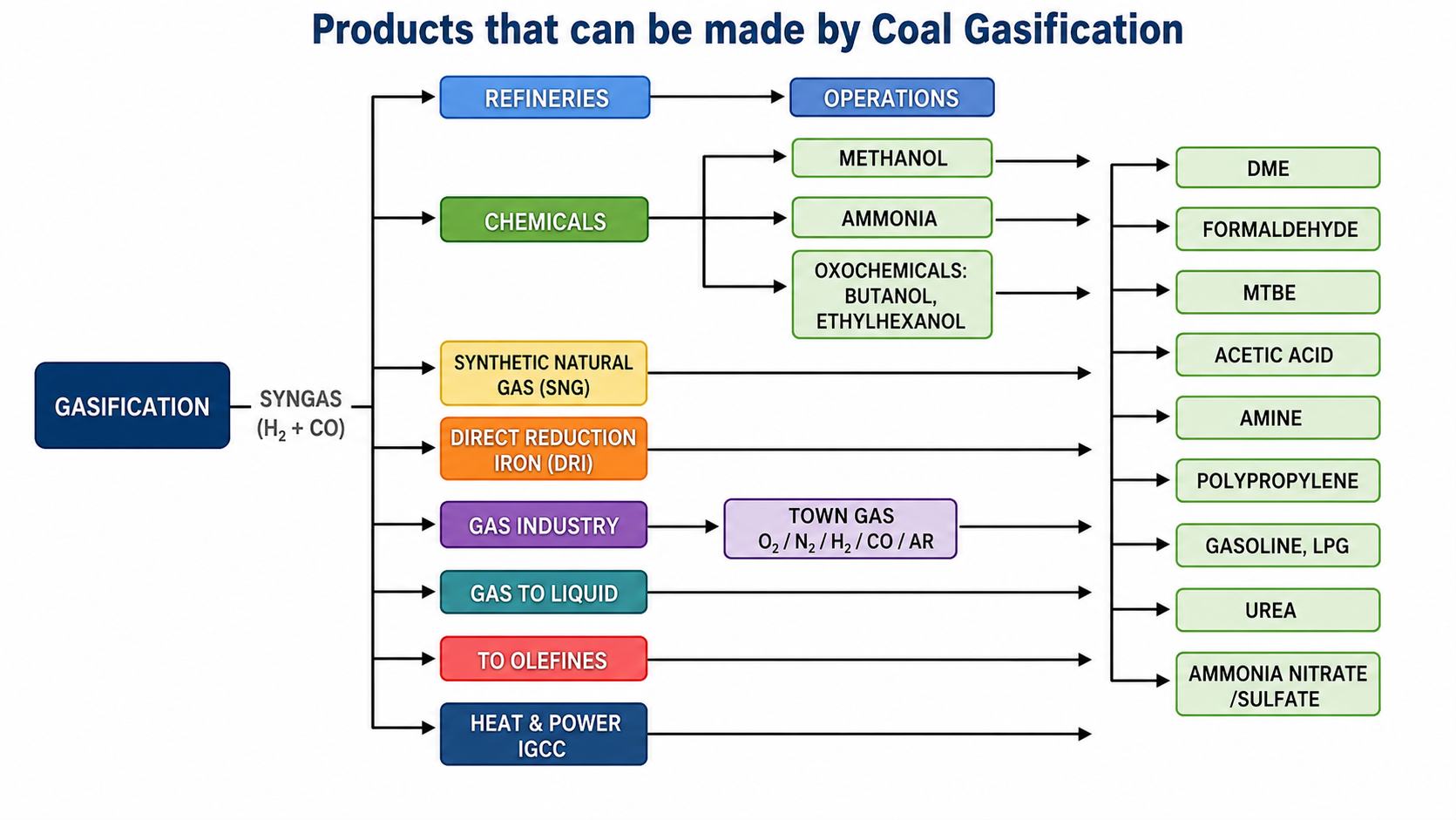
Development of technology
One must go back many decades to understand the development of gasification technology.
Gasification of coal has been known for more than century and half in some industrial form or another. It was messy and there was pollution load. It lost priority with advent of plentiful natural gas and LPG. There were sporadic developments in the USA and Germany on gasifying coal to produce gases that could be converted to industrial products like those derived from petroleum.
An important reason for adoption of coal gasification is that it is a relatively clean technology, with lower pollution and higher thermal efficiency compared to other coal-burning technologies. An study from Department of Energy (DoE), USA, indicates that even if it is used for power generation gasification is superior in terms of thermal efficiency and pollution load. Coal-based Integrated Gasification Combined Cycle (IGCC) plants have thermal efficiencies of 50-55%, compared to 40-50% for the best coal-based thermal power station. The pollution load in terms of SO2 and NOx emissions is also lower with gasifiers.
Coal gasification offers many possibilities for countries that have little petroleum reserves, but are blessed with large coal reserves to reduce their dependence on petroleum products. The Chinese were first off the block when a policy decision was taken some 30 years back to go for massive coal gasification and downstream products. At that time the four companies offering technologies – Texaco, Lurgi, Shell, Conoco, and BGL – were invited and were more or less given a free run to put up plants for Chinese organisations. The initial gasifiers were about 250-tpd (tonnes per day) in size.
Simultaneously, China started indigenising many components that required frequent replacement. The Chinese Government also decided upon a long term R&D programme to develop the technology and this project was given to two universities and fullyfunded by the Government. Technology development commenced in 1995, and culminated in 2005 with a commercial scale demonstration plant being set up. By 2013, there were 14 operating gasification plants with 35 gasifiers, consuming 120,000-tpd of coal. Currently, more than 700 gasifiers are operating in China, with the technology coming from about12 companies (some of whom have merged). The Chinese proudly claim to have broken the western monopoly on gasification technology. It should be noted about 50% of all ammonia and 70% of all methanol in China is coal based.
What is India’s record?
Neyveli Lignite Corporation (NLC) had gasifiers and produced briquettes, fertiliser, phenol, etc. The gasifiers were specifically designed for NLC by Lurgi. The plant was shut down after decades of operations. A similar plant in Dakota, USA, operational since 1985, again with modified Lurgi gasifiers, with an investment of $2.1-bn, has been doing very well, consuming about 6.5-mt of lignite annually, for producing synthetic natural gas, fertilisers, and other by-products. It has paid back all loans. About 40% of revenue is from synthetic natural gas. It is a lesson in perseverance, faith in technology, and innovation. How did we miss the bus?
The Reliance mega project does not impact the gasification ecosystem in India, however it is worth mentioning. The original intention was gasification of a large volume of petroleum coke (petcoke) generated in its two refineries. Mooted in 2011, it was planned to process 6.4-mtpa of high sulphur petcoke – the lowest value refinery product – and was touted to be part of a ‘bottomless’ refinery. Gasification was to significantly boost refinery margins and the project with 10 gasifiers in five modules was to be completed in 42 months by 2018. But it probably achieved integration only in 2021/22. The gasification project was transferred into a wholly-owned subsidiary, Reliance Syngas Ltd.
The Talcher fertiliser project, for producing ammonia and urea, will utilise about 2.5-mtpa of coal from the Talcher mines. This is to be blended with up to 25% petcoke to reduce the overall high ash content in the feedstock used. The Lumpsum Turnkey (LSTK) contract was awarded to Wuhan Engineering Co. Ltd., but it is not clear what gasification technology is being used.
The plant is expected to be functional by October 2024. Wuhuan Engineering, formerly known as the Fourth Design Institute of the Ministry of Chemical Industry, founded in 1958, is now a wholly-owned subsidiary of the central enterprise, China National Chemical Engineering Group Corporation Ltd. (CNCEC).
100-mt target!
In September 2021, the Ministry of Coal came up with a National Coal Gasification Mission, aiming at gasification of 100-mt of coal by 2030. In a notification in January 2024, Government of India provided financial incentives, with a total outlay of Rs. 8,500-crore, for coal gasification projects in three categories:
- In Category I, Rs. 4,050-crore was provisioned for Government PSUs in which up to three projects will be supported by providing lump-sum grant of Rs. 1,350-crore or 15% of capex, whichever is lower.
- In Category II, Rs. 3,850-crore was provisioned for private as well as Government PSUs in which lumpsum grant of Rs. 1,000-crore or 15% of capex, whichever is lower, is provided for each project. At least one project will be bid out on tariffbased bidding process and its criteria will be designed in consultation with NITI Aayog.
- In Category III, Rs. 600-crore has been provisioned for demonstration projects (indigenous technology) and/or small-scale product-based gasification plants under which lump-sum grant of Rs. 100-crore or 15% of capex, whichever is lower, will be given to the selected entity who will have a minimum capex of Rs. 100-crore and minimum production of 1,500-Nm3/hr of syngas.
To achieve the 100-mt gasification target will mean investments in 40 Talcher-type plants, and a minimum total investment at site of Rs. 160,000-crore, along with associated investment in coal mines and infrastructure for evacuation of products.
The aim is to achieve all this in the next 5-6 years. Further, there would be need to dispose or utilise 25-mtpa of ash in some form or other.
A salient point to bear in mind is that the largest single site plant in China has capacity of 6-mtpa of coal with about 25 gasifiers of 4,000-tpd (tonnes per day) each (possibly the largest gasifiers in the world). Several, coal-toolefin plants, producing methanol as an intermediate, have been completed, and typical capacity of propylene is 400-ktpa.
A single gasifier with a capacity of 2,500-3,000 tpd has a weight of about 650-750 tonnes. Gasifiers do not operate continuously; they have to be taken offline for maintenance every 90-100 days. Given our high ash content, the number of gasifiers will be much more than in China, where the ash content is in the range of 6-10%. On average, 2-3 gasifiers are required for a single site. We would require approximately 300- 320 gasifiers for continuity of production – all to be delivered in 4-5 years. At present only Larsen & Toubro (L&T) has the capacity to make such single piece heavy equipment.
It should also be understood that not only heavy equipment, but large turbocompressors and gas turbines are also required for manufacture of methanol, syngas, ammonia, etc. A stupendous task, by any standards!
There is persistent concern regarding high ash content of Indian coals. The Chinese have been operating a plant for many years with 26% ash content. To be sure there were many technical problems in the initial stages, but these have been resolved. Blending with low ash content is a solution.
Morbi Cluster – lost opportunity
Morbi in Gujarat is a large hub in India for production of ceramics, mainly sanitaryware. The firing of kilns at the manufacturing units is done by producer gas obtained from coal by individual units. The total coal consumption was about 8,000-tpd.
This created a lot of pollution in terms of smoke, sulphur dioxide (SO2) emissions, black solids and liquid effluents like tar, etc. The Gujarat Pollution Control Board (GPCB) and later the Gujarat High Court were moved by residents of Morbi to find a solution to the problem. As natural gas was too costly, in 2014, it was suggested that a gasification unit to provide heating gas would solve the problem. Presentations were made to the GPCB and the environment ministry on the feasibility of such a unit. But the reason why it was not taken up is unknown.
Concluding remarks
Despite the obvious economic benefit of gasification there are many challenges. A single project, for one, requires huge amount of engineering man hours. Multiply manifold, and the time constraint is daunting. When a project is on LSTK mode by a foreign company we learn very little and employ few. However, if implemented using local talent along with foreign expertise, it will benefit the nation in the long run.
We have spent almost two decades in meetings and conferences on the topic of gasification. What is holding us back when China has raced ahead?
We will achieve something in the near future as far as gasification is concerned, but the 100-mtpa coal gasification target, though deeply desirable, will likely be elusive!